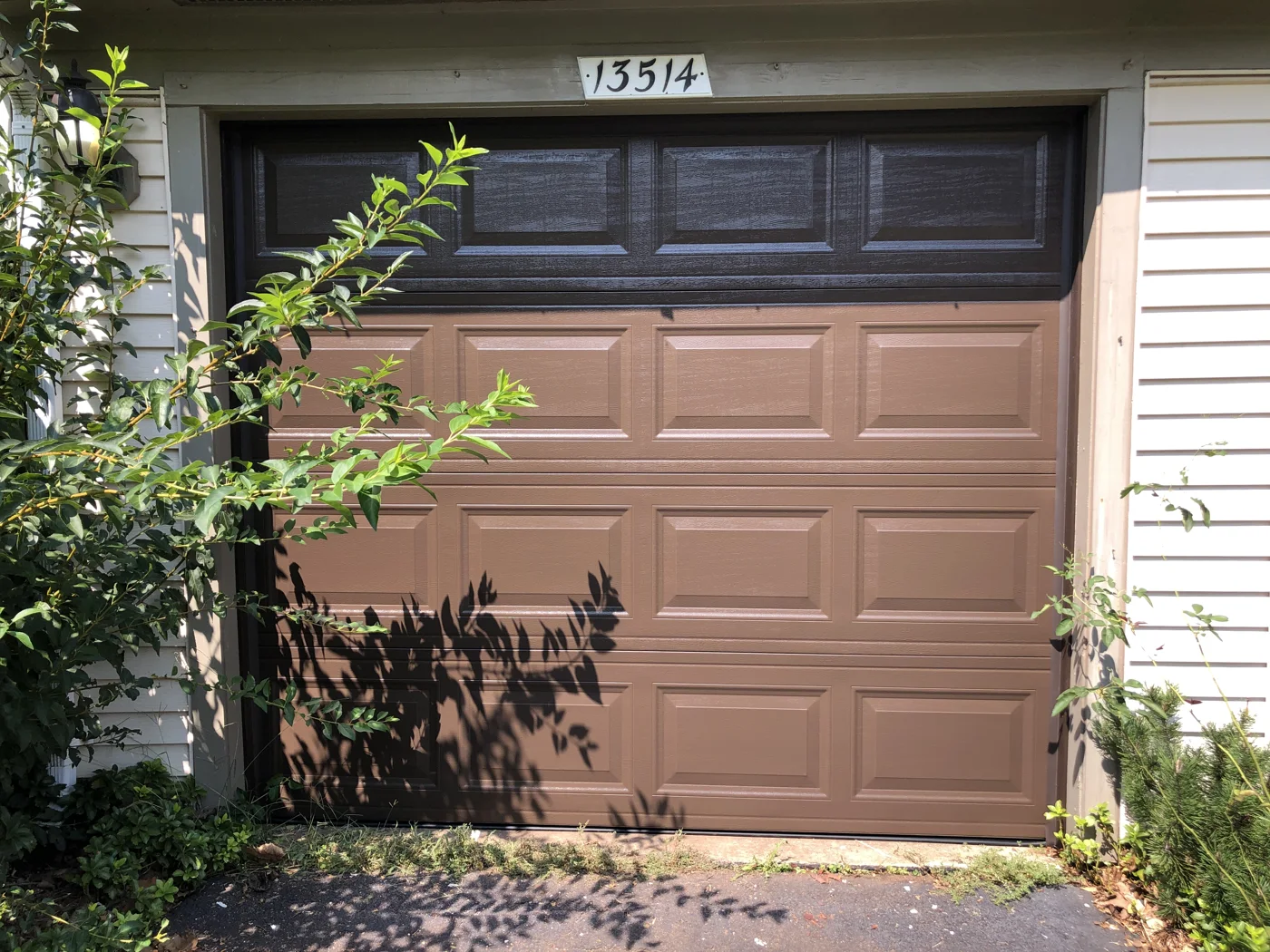

A damaged panel can make a door look ready for replacement even when the rest appears unchanged. The right question is whether a compatible replacement section is available and whether the complete system can be restored appropriately.
Garage door “panels” and “sections” are often used interchangeably in homeowner searches. Give the contractor the actual door identification and a safe photograph instead of relying only on a style description.
Start with the extent of the damage
Clopay advises professional evaluation for major door damage. A dented section, split material, or impact near the hardware deserves assessment before the door is operated again.
Tell the provider what happened and whether the door moved differently afterward. Do not cycle the equipment to demonstrate the damage or remove hardware to inspect it yourself.
Confirm whether a replacement exists
Clopay's FAQ says replacement sections for its steel and wood doors are available where the door model is still manufactured. That statement does not confirm availability for a particular model, size, finish, or order.
Ask the supplier to identify the exact proposed section, how it matches your equipment, and whether the quote depends on a current availability check. Obtain written confirmation before paying for a special order.
Ask about the finished appearance
Request an explanation of how a new section may look beside the remaining door. Ask which appearance concerns the seller has assessed and what is excluded from the price.
Keep appearance and mechanical suitability as separate questions. A similar decorative pattern is not proof that a section is suitable for the existing door. A confirmed compatible section is not automatically a promise of an invisible color match.
Compare complete alternatives
For a section replacement, request the part identity, installation work, associated adjustments or components identified by the technician, removal, total charges, and warranty.
For whole-door replacement, request a separate proposal identifying the new door and everything included. Ask what existing equipment the installer proposes to keep. Comparing those scopes is more useful than comparing a section price with an advertised starting price for a new door.
Keep the purchase decision documented
Agree on the process for an unavailable component, a changed lead time, or a discovered condition requiring additional work. Ask how order changes and cancellations are handled before authorizing a special order.
After installation, keep the exact section or door identification with the invoice. That record can make a future repair inquiry more precise.
Can I replace only the bottom section? Ask the provider to assess the specific door and confirm the compatible component and work required.
Does a panel repair solve track damage too? Only if the assessed scope addresses that damage. Ask what was checked.
What if I meant an opener remote rather than a panel? Identify the equipment and the part you mean before ordering; remote compatibility is a separate question.
Sources & further reading
Sources provide technical background. Worksheets and comparison questions are editorial guidance, not an equipment diagnosis.
Keep reading
Looking for local context?
Explore the NJ and PA area guides for nearby-place references and questions to confirm with a provider. Business coverage and Google Maps links are added only after verification.
A closer look at surface deterioration
Document corrosion separately from dents, cracks and deformation. Appearance alone does not identify the cause or determine whether a section can be replaced.